
Blog
Cabinet hardware: the most touched object in your home deserves more thought

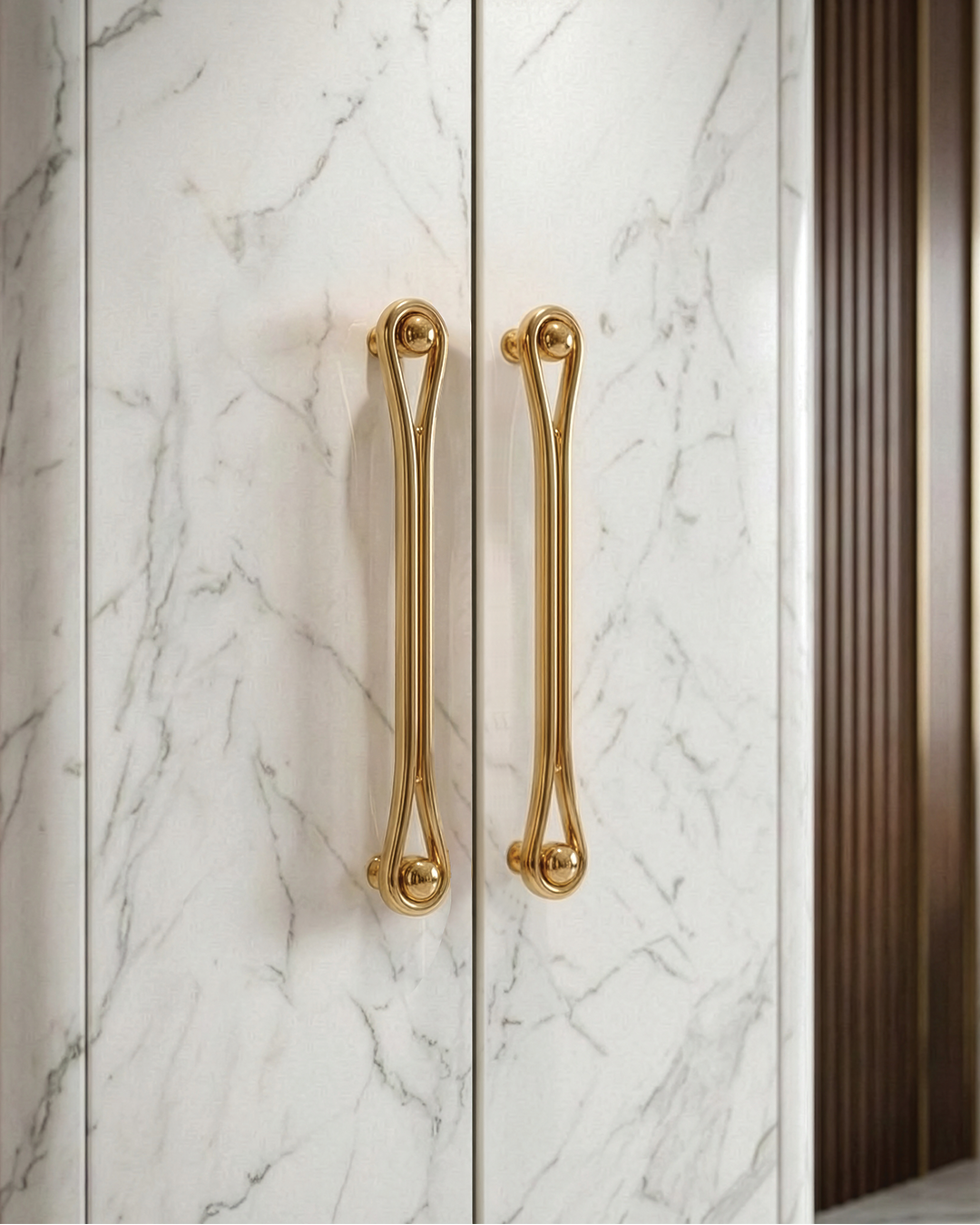
There is a design decision that happens in almost every home renovation, one that gets made quickly, at the end, when budgets are stretched and decision fatigue has set in. It is the choice of cabinet hardware.
Handles. Pulls. Knobs. The small objects your hand reaches for, dozens of times a day, without a second thought.
And that is precisely the problem. Because the things we touch most deserve to be chosen with the most intention, not the least.
At Mukul Goyal, we have spent years designing hardware that resists the throwaway. Pieces that age with dignity. Objects that have a reason to exist beyond the functional. Cabinet hardware, done right, is not a finishing touch. It is a design statement that speaks quietly but continuously, every time a door opens.
This guide is for those who want to make that choice with the same considered eye they bring to everything else in their home.
First, understand what you are actually choosing
Most people approach cabinet hardware as a category. They browse by finishing brass, matte black, brushed nickel and make a decision based on what looks good on a website. This is the wrong starting point.
The right starting point is understanding what these objects actually are.
Knobs are single-point objects, one fixing, one form. They are inherently sculptural in nature. At their best, a knob is a small piece of jewellery set into a door face. At their worst, they are a generic circle that could belong to any room in any house in any decade.
Pulls and handles are two-point objects, a form suspended between two fixings. They offer more grip and leverage, which makes them better suited to drawers and larger cabinet doors. But more than that, they offer more surface space for design to exist. A well-made pull is something you experience across your entire palm, not just your fingertips.
Bar pulls are linear and architectural. They are the handles of a mind that finds beauty in reduction clean, unhurried, precise.
Groove handles are recessed into the cabinet face itself. No protrusion, no shadow, no announcement. They are the most disciplined form of handle design form reduced to pure function, and somehow, through that reduction, made more beautiful.
Cup pulls are scooped and tactile, carrying with them a sense of history and domestic craft. They belong on the kind of furniture that gets handed down.
None of these is better than the others. Each is a character. Your job is to find the right character for the room.
The room is the brief
In product design and cabinet hardware is product design, the context is the brief. The room tells you what it needs. Your job is to listen.
The kitchen
The kitchen is honest. It does not tolerate pretension. Hardware that is too ornate will trap grease and betray itself within months. Hardware that is too timid will disappear against the scale of a full run of cabinets.
What works here is clarity. Bar pulls with clean returns. Groove handles that give you a full grip when your hands are wet or full. Brass is always a strong choice in a kitchen because it does not hide what it is. It develops a patina with use. It becomes more itself over time, not less.
For upper cabinets, where the gesture is lighter, shorter pulls or knobs work well. The upper zone should feel lighter visually; hardware that is too heavy here tips the whole room forward.
The wardrobe
The bedroom wardrobe is a daily ritual. You reach for it in the half-dark, with half a mind still in sleep. The hardware here should feel good before it is seen.
The long bar pulls in warm brass or antique bronze feel generous and calm. Groove handles recessed, seamless, barely there let the door material become the design: the grain of the timber, the texture of a lacquered surface, the quiet geometry of a panel.
Avoid under-scaling here. A large wardrobe door with a small knob creates a mismatch that no amount of good taste elsewhere will fix. Scale your hardware to the door, not to your hesitation.
The bathroom vanity
The bathroom demands cohesion above all else. In a small, enclosed space, every metal surface speaks to every other. Brass hardware against chrome taps creates a visual argument that the room cannot win. Choose a metal family and commit to it.
For the vanity itself typically smaller drawers, lighter doors, short bar pulls or considered knobs work beautifully. In brass, they bring warmth against the typical coolness of marble or ceramic. In brushed nickel, they hold back and let the material speak.
Moisture matters here too. Solid brass, correctly finished, is the most durable choice for a humid environment. Thin platings over base metal will tell you their secret within a year.
The home office
This is where the rules loosen. The study is a personal space, a room built around the way one person thinks, works and finds focus. Its hardware can be expressive, even eccentric, in a way that a kitchen cannot afford to be.
A sculptural knob on a cabinet door. A weighted brass pull that you look forward to reaching for. A handle that is also, quietly, an object worth examining. These are the details that make a study feel inhabited rather than furnished.
If your desk carries Mukul Goyal accessories, a pen stand, a card holder, a paperweight — let the hardware carry the same material conversation. The consistency of brass across every touchpoint in a room is what creates the feeling of a space that has been designed all the way through.
On finish — and why it matters more than you think
Finish is the most visible quality of hardware and the quality that will age most honestly. Choose it carelessly and it will tell you so within a few years.
Brass is our material of choice not by accident, but by deep conviction. Brass is honest. It does not perform permanence; it earns it. A living brass finish develops a patina over years of use, and that patina is evidence of a life lived alongside the object. It becomes more beautiful with handling, not less. This is what we mean when we say that good design combats obsolescence not just physically, but emotionally. You cannot feel that way about a chrome-plated knob from a catalogue.
Brushed nickel is cool, restrained and highly practical. It holds fingerprints less visibly than polished surfaces, which makes it an honest choice for high-use kitchens.
Matte black is graphic and bold. It works alongside warm timber tones and raw textures, Japandi-influenced interiors, industrial kitchens, spaces that are not afraid of contrast. Used without grounding, it can feel stark. Used with intention, it anchors a room.
Antique bronze and aged iron carry history in their surface. They suit spaces with a sense of accumulated character, the home that has grown over time rather than been installed all at once.
On mixing finishes: choose one dominant finish and allow one accent. No more. The home that mixes three metal families across its hardware is a home in quiet, constant visual argument with itself.
On proportion — the most overlooked dimension
The most common hardware mistake is not the wrong finish or the wrong style. It is the wrong scale.
Hardware that is too small for its door face disappears. It becomes apologetic present but unconvincing. And an apology in design is worse than an absence.
A useful guide: the length of a pull should be roughly one-third of the width of the door or drawer it serves. A generously sized drawer deserves a generously sized pull. Do not under-scale out of caution; it never looks more refined. It only looks smaller.
Centre-to-centre measurement — the distance between the two fixing holes is the only number that matters when replacing existing hardware. New hardware must match this measurement, or you will be filling and re-drilling. Measure before you order.
Knob placement on a door is typically the upper corner — 25 to 50mm from each edge. In a small drawer, center it. On a wide drawer, consider two knobs placed symmetrically. Symmetry in hardware placement is not a rule. It is a form of respect for the object.
What makes hardware worth keeping
There is hardware that is bought, installed and forgotten. And there is hardware that is noticed, appreciated and eventually missed when it is gone. The difference is not dramatic. It is in a few specific qualities.
Weight is the most immediate signal. Hold a piece of solid brass. Hold a hollow zinc casting beside it. The conversation ends there.
Finish consistency is what separates a considered piece from a produced one. Under good light, examine the surface across its full length. Premium hardware will be even, with no blotching, no thin edges, no places where the finish thins to reveal what is underneath.
The fixing quality — the screws, the thread tells you whether the maker thought about installation or only about the object itself. A stripped screw on day one is a message about everything that came before it.
Hand-finishing is what we practise at Mukul Goyal and what changes everything. When a piece passes through skilled hands rather than solely through machines, it carries something that tooling cannot replicate: a quality of surface, a weight of attention, a sense that someone decided this piece was finished rather than simply done.
Our hardware is shaped by craftspeople who understand that the objects we interact with most deserve the most care. Sixteen pairs of hands, working across traditional and contemporary techniques, producing pieces in recycled brass that are designed not to be replaced, but to be kept.
Before you choose — the questions worth asking
Not a checklist. A set of questions.
Does this piece have a reason to look the way it looks or does it simply fill a category?
Will this finish still feel right in ten years, or does it belong to this particular moment in the interior trend?
Does the weight of this object in my hand feel like something worth reaching for every day?
Am I choosing this because it is right for this room, or because it was the easiest decision to make at the end of a long renovation?
Good hardware does not demand to be noticed. It simply makes the moment of opening a door a moment that happens dozens of times a day, for years — feel like it was considered.
That is what we design for.
Explore the collection
Browse the Mukul Goyal cabinet hardware collection — handles, pulls, knobs and groove hardware, designed in New Delhi and crafted in solid brass and premium metals.
→ View cabinet hardware → View brass handles collection → Contact our design team for bespoke commissions


